Three Futures for One Uncertain Question
Three futures for one uncertain question help a group compare distinct possibilities, expose dependencies and prepare better questions without treating any as a prediction.
The common mistake in a three-scenario exercise is to treat the hopeful future as a destination and the difficult one as a warning. That turns a useful comparison into a contest over which story feels most convincing. Three futures for one uncertain question work better when each account tests a different set of conditions and shows what people might need under them.
What question should the scenarios answer?
Begin with a question that names a genuine uncertainty and a clear subject. “How might our neighbourhood get around if private car use changes?” gives a group something specific to explore. “What will transport look like?” is too broad, while “How do we reduce car use?” assumes the desired result before the exercise begins.
Choose a time horizon that gives change room to unfold while remaining relevant to the decision under discussion. State whose experience matters: residents, a local service, a business or the whole community. Keep the question visible throughout the exercise; it is the frame for each scenario, not a prediction in disguise.
How do you keep the three futures distinct?
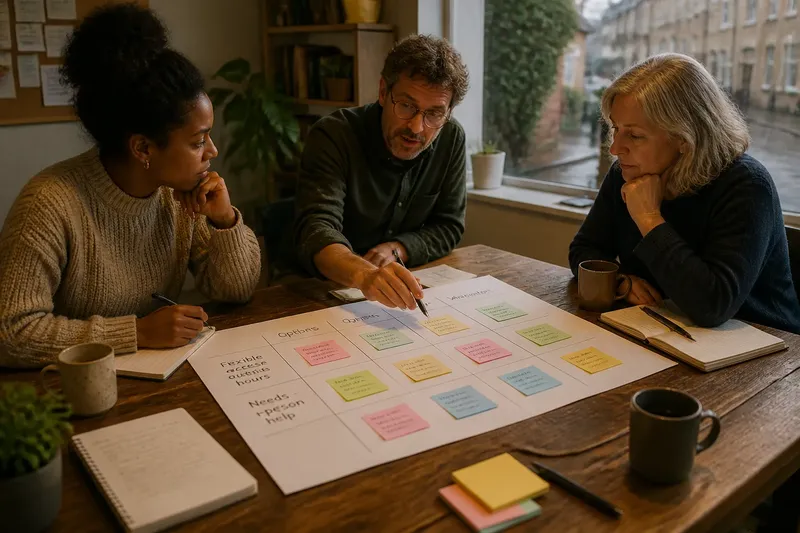
Give each scenario a different organising condition, rather than changing only the tone. One might explore what happens when access improves, another when transport services become harder to rely on, and a third when current travel patterns mostly continue. Each should describe a connected situation, not a list of unrelated events.
Set a shared starting point so the scenarios belong to the same exercise. For the transport question, note the services and travel options available now, the people affected and any constraints the group cannot simply wish away. If participants dispute a starting fact, mark it for later checking instead of letting the disagreement derail the scenario work.
Then make the differences explicit. A helpful way to think of the three accounts is as routes drawn on the same map: the starting place is shared, but each route passes through different conditions and leads to different practical challenges.
What should each scenario reveal?
A hopeful scenario should be appealing but coherent. Ask what would have to go well, who would benefit and what services or arrangements would support the change. It is not a perfect world: useful friction, such as a group that still struggles to reach essential places, makes the account more informative.
A difficult scenario should explore pressures that connect to the question, without piling on unrelated disasters. Describe what people encounter, what becomes fragile and what needs emerge. The point is to expose dependencies—such as the importance of regular bus service to a journey—rather than to predict a crisis or assign blame.
A business-as-usual scenario is not a claim that nothing changes. It asks what might follow if familiar habits and arrangements mostly persist, alongside adjustments that are already easy to imagine. Describe who continues to find travel convenient, where access remains difficult and which existing pressures carry on.
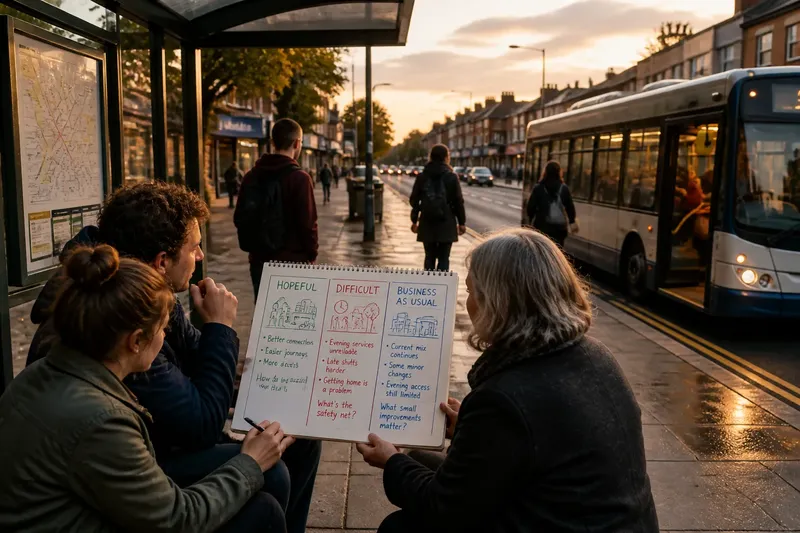
Say a neighbourhood group starts with the invented conditions that buses serve the main shopping street, some residents rely on cars, and evening connections are limited. In its hopeful account, a new connection makes common work and school journeys easier, so the group records that people without cars may gain access while asking how the service would be maintained. In its difficult account, evening journeys become less dependable, so the group identifies residents with late shifts as especially exposed and notes the need for another way to reach home. In its business-as-usual account, the current mix of travel continues with minor route changes, so the group expects familiar journeys to remain workable for some while evening access stays a concern. These are invented possibilities, not forecasts; each produces a different question about access and service dependence.
How can you compare the scenarios fairly?
Apply the same prompts to all three accounts. The comparison should make practical differences visible, not reward whichever story has the most vivid details.
- Changed condition: Check what is different from the shared starting point; if the change is unclear, revise the scenario, and if it is clear, keep it visible.
- People affected: Check who notices the change first; if a group is missing, add its experience, and if the affected groups are clear, examine how their needs differ.
- Practical benefit: Check what becomes easier in daily life; if no concrete benefit appears, sharpen the account, and if one does, identify who can access it.
- Practical difficulty: Check what becomes harder; if the burden falls unevenly, name who carries it and consider another condition, and if it is broadly shared, describe the common pressure.
- Dependency: Check what must remain available for the scenario to work; if that condition is fragile, note a fallback to explore, and if it is dependable within the scenario, state what supports it.
- New question: Check what the account makes the group ask; if it raises no new question, revise its distinguishing condition, and if it does, record the question for the next discussion.
Keep the detail comparable. If one account explains who travels where and another offers only a broad mood, fill in the thinner account using the same prompts. That makes it easier to compare consequences without pretending that the scenarios are equally attractive or equally plausible.
What questions help keep the exercise grounded?
How are scenarios different from forecasts?
A forecast estimates what someone expects to happen; a scenario describes a possible set of conditions and asks what they could mean. Treat each scenario as a structured “what if?”, not as a claim about what comes next.
Does the hopeful scenario have to be the most likely?
No. It needs to be coherent enough to examine, but its purpose is to explore what could improve and what conditions would support that improvement. Keep its possibilities distinct from a promise or a plan.
What should the group do when people disagree?
Keep the disagreement visible and identify which condition or dependency prompts different views. If the group cannot resolve it, record both interpretations and the question that would help clarify them.
How many details should each scenario include?
Include enough to show how people experience the future, what changes and what it depends on. Use the same comparison prompts for each account so that one does not receive special treatment.
What should happen after the comparison?
Read the accounts side by side and look for needs that appear across more than one future, as well as trade-offs that change from one to another. Notice who is well served in one scenario but poorly served in another. The purpose is not to merge the accounts into a single version judged “most realistic”.
Return to the original question and record what the exercise has made clearer or harder to answer. The neighbourhood group might ask which journeys are poorly served across all three futures, or what residents would need if evening connections became less dependable. Those questions can inform a later discussion without turning the scenario exercise into a decision by itself.
When sharing the three futures, label them as possibilities and include the shared starting point and the condition that distinguishes each one. That context helps readers see why the accounts differ—and keeps three futures for one uncertain question useful as a way to prepare for change, rather than a claim to know what will happen.