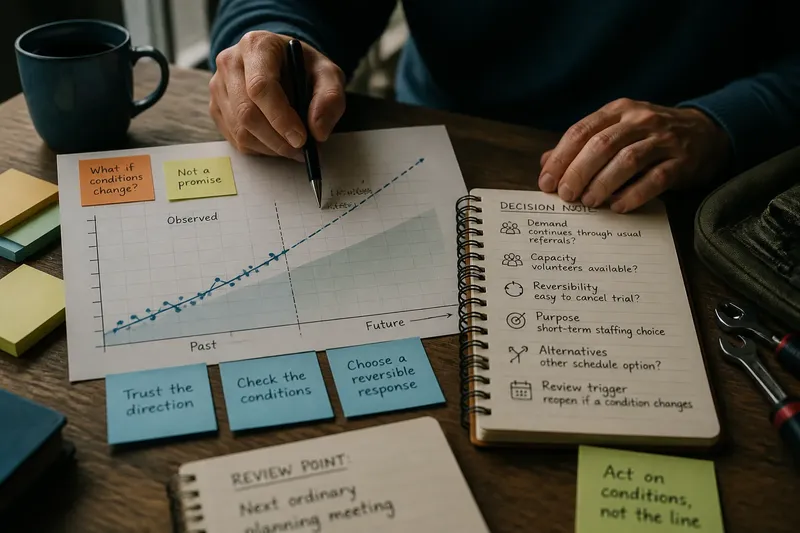
A Signal Is a Clue, Not a Forecast
Learn to read a signal without mistaking it for a forecast: separate what changed from the story, check its context and choose what to watch next.

The common mistake with a signal is to treat a striking change as proof that a larger shift has begun. A team hears that a local library has extended its opening hours and concludes that public services are moving online less quickly. The cost is not merely a premature prediction: attention and decisions can become tied to a story that the clue cannot support. A signal is useful precisely when you keep the observation separate from its interpretation.
Use the following checks to make that separation. They are not a formula for predicting what comes next. They help you say what you actually know, what you are adding to it, and what further observation could make the clue more informative.
1. What exactly changed?
Write the observation in plain, bounded language before explaining it. Include who or what changed, what was different, and where the change was visible. “A council library extended evening hours at one branch” is an observation. “People are returning to shared public spaces” is already an interpretation.
This distinction matters because broad wording can smuggle a conclusion into the description. If you cannot point to what someone could directly see, read or hear, the sentence may already be carrying assumptions. Keep the first note close to the source: a service notice, a product release, a changed workplace practice, or a new requirement in an organisation’s own guidance.
Concrete details do not make a clue more important; they make it easier to examine. A loose button is not evidence that a coat is falling apart. It is a specific observation that may call for a closer look.
2. Which part is interpretation?
Place the observation beside the story you are tempted to tell about it. Ask what you inferred about causes, scale, direction or permanence. Those may be sensible questions, but they are not contained in the original clue.
For instance, a newly introduced tool might signal a change in how a team works. It might instead be a limited trial, a response to a temporary staffing gap, or an option used by only one group. Until you have more context, “the organisation is replacing its old process” goes beyond “a team has begun using a new tool”.
A useful note keeps these claims in separate columns:
- Observed: the specific change and where it appeared.
- Interpreted: the possible meaning you are considering.
- Unknown: the missing context that would help distinguish explanations.
That simple separation makes it easier to revise a view without pretending the first observation never happened.
3. How broad is the clue’s reach?
A visible change may be real and still be narrow. Ask whether it concerns one person, one site, one organisation, one group of customers or several independent settings. Then be precise about the scale of any claim you make.
Say you notice that a neighbourhood café has added a shelf for customers to leave and take books. You could record the change and wonder whether informal sharing is becoming more popular locally. You would not yet have a basis for saying that reading habits are changing across the country. The observation is concrete; the larger claim needs evidence from beyond that café.
Scope is not a reason to dismiss small clues. A local change may be worth watching because it raises a useful question or exposes a possibility others have overlooked. Its reach simply sets a limit on what it can support right now.
4. What else could explain the change?
Before settling on an explanation, name at least one alternative. A single cause may feel obvious because it fits a current concern, but another account can fit the same observation. Alternatives protect you from confusing a plausible story with the only story.
Imagine that a school begins offering more lessons through recorded material. One interpretation is that teaching is moving towards more independent study. Another is that staff are using recordings to cover a temporary timetable disruption. A third is that the recordings supplement classroom teaching rather than replace it. The next useful observation would depend on which explanation you want to distinguish: for example, whether the practice continues after the disruption or appears in other subjects.
Do not invent alternatives merely to make every explanation seem equally likely. The point is to identify what else could account for the clue and what observable detail might help separate the possibilities.
5. What would make the clue stronger or weaker?
Choose an observation that would change your interpretation, rather than collecting every new detail about the topic. A clue becomes more informative when later observations connect to it in a way that is relevant to the proposed explanation. Repetition in the same setting may show persistence there; appearances in different settings may suggest wider reach. Neither alone proves a sweeping forecast.
Be equally clear about what would weaken your reading. If you think a new service reflects a lasting change in user preference, ask what you would expect to see if it were only a temporary response. If the service closes when a specific disruption ends, that would make the temporary explanation more compelling. If it continues, the lasting-change idea may deserve further attention, though other explanations can remain.
This is a disciplined way to watch: not “find more evidence for my idea”, but “notice what could move my view in either direction”.
How should you use a signal without calling it a forecast?
Can one unusual event count as a signal?
Yes, if you describe it as a clue that raises a question rather than as proof of a broad change. Record its setting and limits so that its significance can be reconsidered if related observations appear.
How is a signal different from a trend?
A signal is an observation that may point towards a possible change; a trend describes a pattern across observations over time or across settings. One clue can prompt you to look, but it does not establish a pattern by itself.
What if two people interpret the same clue differently?
Compare the observation they agree on, then make each person’s interpretation and missing information explicit. Disagreement can reveal which assumptions need checking, rather than requiring an immediate choice of one story.
When should a clue affect a decision?
That depends on the decision’s reversibility and consequences, as well as the quality of the available information. For an important commitment, consider seeking relevant expertise and make clear which parts of the decision rest on uncertain interpretation.
6. What decision, if any, can the clue support?
A clue may justify paying attention without justifying a major commitment. Separate actions that improve your understanding from actions that assume the interpretation is already true. Asking a colleague to check whether a change appears elsewhere is different from reorganising a whole service around the belief that the change will spread.
When a choice cannot wait, state the uncertainty alongside the decision. You might say, “We are treating this as a possible sign of changing demand, not as evidence that demand has shifted across the whole organisation.” That wording does not weaken sound judgement; it helps others see what the decision depends on and what might prompt a review.
The phrase signal is a clue, not a forecast is most useful as a writing habit. Keep the observed change distinct from the meaning you assign it, name what remains unknown, and decide what evidence could alter your reading. Then a small, surprising observation can inform attention without being asked to predict the future on its own.