A Five-Question Reset for a Stuck Future
A five-question reset for a stuck future helps loosen one fixed picture, explore credible alternatives and decide what to ask or notice next.

The common mistake with a stuck future is to keep polishing the same picture: adding detail to a prediction that already feels settled. A five-question reset for a stuck future shifts attention from refining that picture to exploring what it leaves out, so a decision need not rest on an unexamined assumption.
This is a futures-literacy exercise: a way to use imagined possibilities to think more clearly about change, not to predict which outcome will happen. It is especially useful when a conversation keeps returning to one familiar story, even though the conditions around it are uncertain.
What does the five-question reset ask?
Choose one specific question about change. It might concern how a team’s work could shift, what a neighbourhood may need, or how a personal plan depends on an uncertain condition. A focused prompt gives imagination something to work with; “What will the future be like?” is too broad to guide a useful discussion.
Write these questions where you can see them:
- What future picture am I treating as settled? Describe it in a sentence, including the assumption that makes it feel likely.
- What else might be possible? Name an alternative that changes something meaningful, not just a minor detail.
- Whose account of this situation might differ from mine? Consider how someone’s role, needs or experience could lead them to notice different conditions.
- What would have to be different for that alternative to matter? Name a condition, choice or development that would make it more relevant to the decision.
- What question or observation would help us distinguish between these possibilities? Choose something people can actually ask or notice, rather than a vague wish for more certainty.
The questions do not identify a single correct future. They make it easier to separate present conditions from assumptions and imagined possibilities. It is like turning a mug in your hands: the subject stays the same, but a different side comes into view.
How can you run the reset without repeating the same story?
Change the starting point, not just the wording. Instead of asking everyone to imagine a different outcome in the abstract, invite them to begin from a specific condition, place or point of view. This moves the conversation away from generating alternatives for their own sake and towards understanding how a change in circumstances could alter the decision.
- Check the first picture: If it describes a condition as certain, then rewrite it to distinguish what is already happening from what you expect; if you cannot separate them, ask what evidence or experience led you to combine them.
- Check the alternative: If it changes only a detail, then choose a possibility that would call for a different response; if no meaningful alternative comes to mind, ask someone outside your usual discussion what conditions they consider.
- Check the missing perspective: If the same roles keep speaking, then invite someone affected by the decision who has not yet contributed; if inviting them is not practical, write down which experience is absent and what question could represent it.
- Check the condition behind the alternative: If it depends on a named change, then ask what people could observe that would make it relevant; if it depends on an imagined event no one can assess, revise the alternative around a condition that can be discussed.
- Check the next question: If it can be answered through a conversation or an observable sign, then decide who will ask or notice it; if it is too vague to act on, narrow it to one uncertainty that could affect the choice.
- Check the decision’s reach: If one person can explore the question without committing others, then begin privately or with a conversation; if several people will bear the consequences, invite them to contribute before the group settles on a response.
These checks are not a substitute for forecasting or specialist advice. Their purpose is to make the assumptions in a discussion easier to see and to give people a clearer reason for continuing, changing course or pausing.
Should you write alone, talk it through or work as a group?
When does a private written reset suit you?
Writing alone suits a question that feels personal, delicate or not yet ready for discussion. A notebook gives an unpolished thought room before you have to explain or defend it. Keep the first picture beside the alternative so you can see what changed.
If your notes circle around the same explanation, writing may not be enough. That is a cue to seek a different starting point, perhaps through a conversation with someone who encounters the issue from another position.
When is a one-to-one conversation more useful?
A conversation can help when you have named an assumption but cannot see beyond it. Ask someone who encounters the issue differently to answer the questions in their own words, then compare what each of you noticed.
For example, a colleague who works directly with service users may describe obstacles that are hard to see from a planning role. The point is not to treat their view as a complete account, but to let a different position change what the discussion considers.
When should you invite a small group?
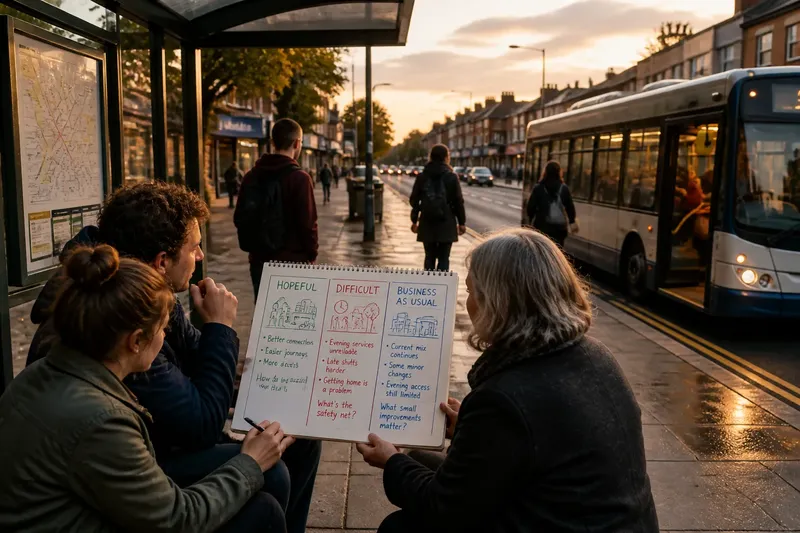
A group can help when several people will be affected by a shared decision. Ask everyone to write a response to the first two questions before discussion begins. This gives quieter participants a chance to offer an alternative before the most familiar account sets the tone.
If people feel they must defend a department or an existing plan, begin with private writing or pairs. Bring the group together once there is room to consider how different starting points could change the choice.
How do you choose the right approach?
Match the approach to what is keeping the picture fixed. If you have not yet put your assumption into words, write privately. If you have named it but cannot imagine a different account, speak with someone who meets the issue from another position. If the decision affects several people, let them think independently before discussing it together.
Say you are planning a community garden and have settled on individual plots because you assume residents want their own space. In a private note, you list shared growing areas as an alternative. You then speak with a resident who has limited time, who says that shared maintenance and easy access matter more to them than owning a plot. At a group meeting, people agree to ask residents which features would make them more likely to use the garden before choosing a layout. The resulting decision is to gather views on access, maintenance and plot ownership before committing—not to treat any one imagined design as certain.
This worked example shows how the reset can change the question under discussion. Instead of asking which layout is best, the group asks what residents need from a garden and how those needs should shape the choice.
What questions help when a future picture feels fixed?
How can I tell an assumption from an observation?
An observation describes something someone can point to in the present, while an assumption interprets what it means or predicts what follows. Write them separately, then ask what information could make the interpretation more or less convincing.
What makes an alternative useful?
A useful alternative changes a condition that could affect the decision, rather than adding decorative detail. Ask what would need to be different for the alternative to matter and what question could help people assess that condition.
What if the group cannot agree on a possible future?
Agreement is not required to use the exercise. Record the different starting assumptions, then identify what each person would need to ask or notice before choosing a response.
How should I respond to an idea that challenges my view?
Do not replace one fixed story with its opposite. Ask what would have to be true for the new possibility to matter, and whether that condition can be explored through a conversation or an observable sign.
What should you do after the reset?
Keep the most useful open question beside the decision it informs. If it points to a missing perspective, ask who could offer it; if it points to a condition that could change the choice, agree on what people will notice and when they will revisit the discussion.
A five-question reset for a stuck future earns its place when it changes how you frame the decision, not when it produces a confident prediction. The next time the conversation settles too quickly, return to the condition behind the assumption and ask what would make the group see the choice differently.