Keep a Choice Useful Across Several Outcomes
Keep a choice useful across several outcomes by comparing what each path makes possible, then committing only when the trade-offs are clear.
The common mistake in an uncertain decision is to treat the first plausible future as the one that will happen. A team might commit its whole budget to a new service because demand seems likely to grow, only to discover that customers want something different. The cost is not simply a poor prediction: it is losing room to respond. A better decision compares what different futures would make possible, then chooses a commitment that still serves its purpose when circumstances change.
How can you compare choices across several futures?
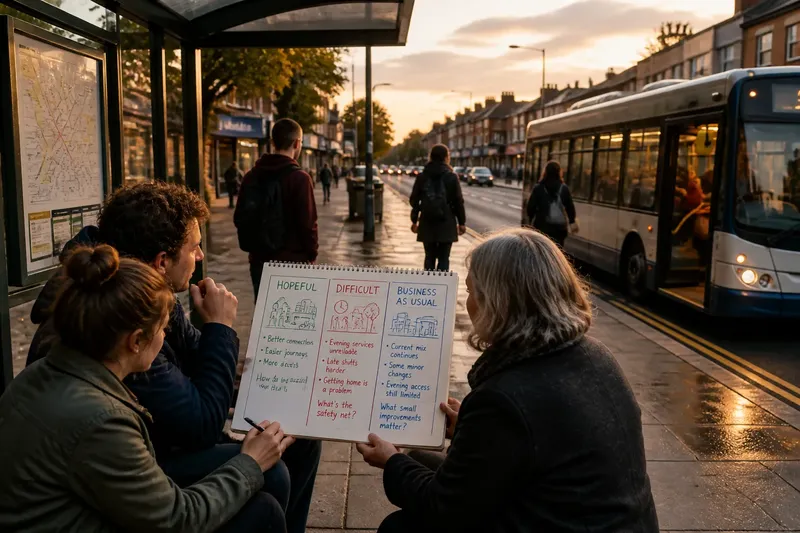
Start with the outcome you want, then describe a few plausible futures that could affect how you reach it. These are not forecasts or predictions. They are distinct, coherent accounts of what might change, such as customers preferring a different way to access a service, a supplier changing its terms, or available staff time becoming tighter.
Next, compare the decision options against each future. Ask what each option would help, hinder or require you to give up. A choice is robust when it remains useful across different conditions; it is fragile when it depends heavily on one particular future being right. Robust does not mean perfect or risk-free. It means you can explain why the option still makes sense when an important assumption changes.
Think of the comparison like packing a bag for changeable weather. You do not need to pack for every imaginable storm, but you do want to know whether your choices leave you prepared for more than one likely turn in the day.
What should you compare before committing?
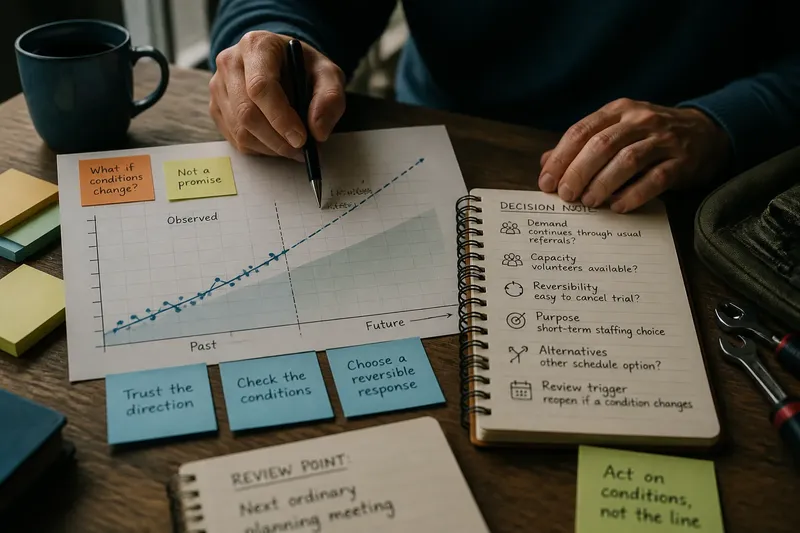
Use a short decision note to make the comparison visible. Write down the outcome you want, the plausible futures you considered, the options available and the consequences that matter. Keep the scenarios distinct enough to reveal meaningful differences; changing a minor detail while keeping the same underlying conditions adds little.
- Check the aim: If the option advances an outcome that matters in several plausible futures, keep it in consideration; if it serves only a discarded priority, revise the aim or remove the option.
- Check the assumptions: If the option depends on a belief that could change, identify that dependency; if you cannot explain why the belief is credible, compare an option that relies on a different assumption.
- Check the affected people: If a future would leave a group without a workable way to use the service, add a suitable safeguard; if no safeguard is feasible, reconsider the option.
- Check the resources: If the option remains manageable when staff, time or supplier support changes, retain it for comparison; if it becomes impractical, reduce its scope or consider another route.
- Check what is given up: If the option’s benefits justify the alternatives it closes, record that trade-off; if they do not, choose a path that preserves the more valuable alternative.
- Check the decision point: If the remaining uncertainty could change your choice, name the event or new information that would prompt a review; if it would not affect the choice, proceed without treating it as a reason to delay.
These checks should lead to an actual choice, not an endlessly expanding list of possibilities. When two options work similarly across the futures you consider, choose between them using the priorities that matter most to the people affected. Where consequences involve safety, contracts or specialist duties, seek advice from a qualified professional.
What does a worked scenario comparison look like?
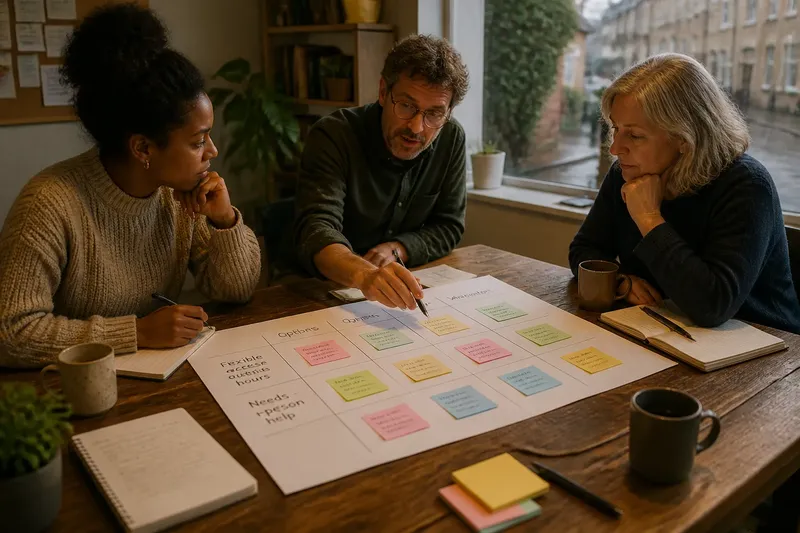
Say a neighbourhood organisation wants to make advice sessions easier to attend, but does not know whether people will prefer evening meetings or remote appointments. For this invented situation, it considers two possible futures: people mainly need flexible access outside working hours, or people need in-person help because the advice is difficult to use alone. The organisation compares three options: keep the current daytime sessions, add evening appointments, or offer remote appointments.
It then records the trade-offs. Daytime sessions require no new format but do little for people who cannot attend then. Evening appointments could help those people, but depend on staff availability. Remote appointments could reduce travel barriers, but may not suit someone who needs in-person support. Instead of declaring one future most likely, the organisation chooses to ask service users about access barriers and arrange a limited trial of both new formats using existing staff and rooms.
The resulting decision is not that one format has already succeeded. It is that the organisation will compare who can use each option, what support staff need to provide and which barriers remain. If evening appointments cannot be staffed, it can stop developing that option; if remote appointments leave some people without adequate support, it can retain an in-person route. The trade-off is extra coordination now in exchange for a clearer basis for a later service decision.
When should you choose firmly rather than keep comparing?
More comparison is useful only while it could change the decision. A deadline, a shared dependency or the cost of maintaining several options may make further delay unhelpful. If the same option serves the aim across the futures that matter, and the unresolved differences would not alter your choice, commit and record the trade-offs you accept.
Choose differently if a plausible future exposes a serious weakness that you cannot address. You might change the option, add a safeguard, or state openly that you accept the risk because the alternative is worse. Where the impact on people or obligations is significant, make the reasoning clear enough for those affected to understand how the decision was reached.
Which questions help clarify a scenario comparison?
How many futures should I consider?
Include enough distinct futures to reveal different consequences, rather than trying to list every possibility. If adding another scenario does not change the options or trade-offs, it may not help the decision.
What is the difference between a scenario and a forecast?
A forecast claims that some outcomes are more likely than others. A scenario is a plausible account of how conditions could develop, used to examine what a decision would mean if those conditions arose.
What if every option performs poorly in one future?
Identify what makes that future difficult and whether a safeguard or a different option could reduce the harm. If no available choice addresses it adequately, make the limitation explicit and seek relevant specialist advice where the consequences warrant it.
How do I know when comparison is complete?
Stop when you understand the meaningful trade-offs and additional scenarios or information are unlikely to change your choice. Record what you are accepting, then identify what kind of change would justify reopening the decision.
To keep a choice useful across several outcomes, compare options against distinct futures rather than treating one plausible account as certain. The point is not to preserve every possibility; it is to see what your decision depends on, recognise what it rules out and commit with those consequences in view.