The Assumption Hidden in a Straight-Line Forecast
A straight-line forecast can make a trend look settled. Learn to expose its hidden conditions and choose a sensible response before planning around it.
The common mistake in a straight-line forecast is to treat a visible direction as a dependable future. A team sees demand rising, extends the line and plans around the result. The cost is a decision built on conditions that may not last, such as spare capacity or easy access to a supplier.
A straight-line forecast extends an observed trend into a later period. It is a conditional sketch: it shows what the trend would imply if its supporting conditions continued. The useful question is not whether the line is right, but what decisions remain sensible if those conditions change.
What does a straight-line forecast leave out?
Imagine a line rising across a chart. It records a direction, but extending it also assumes that the forces behind that direction will keep producing a similar effect. Demand might depend on customer habits, staff availability, supplier capacity, regulation, prices or a competing service.
Some forces can weaken as a trend grows. A new service may attract people because it is easy to try; as it reaches people with different needs, that appeal may fade. A forecast that carries the original pace forward without considering this possibility can make a plan more confident than its basis warrants.
A straight-line forecast is like a ruler laid across a map: useful for tracing a direction, but unable to show a bridge closure or a new hill. The line is not useless; it simply leaves out the conditions that could redirect the route.
How can you make the assumption matter to a decision?
Rather than catalogue every possible cause of a trend, connect the forecast to the choice it is meant to support. Ask what the organisation would do if the projected direction continued, slowed or reversed. This makes the assumption practical: it becomes a condition for action, not just a sentence beside a chart.
Say a neighbourhood repair service is considering adding an evening session. Its forecast extends a recent rise in requests. The decision depends not only on whether interest continues, but also on whether volunteers can staff the session and whether requests come through ordinary referral routes rather than a single event.
A useful planning note can connect these points directly:
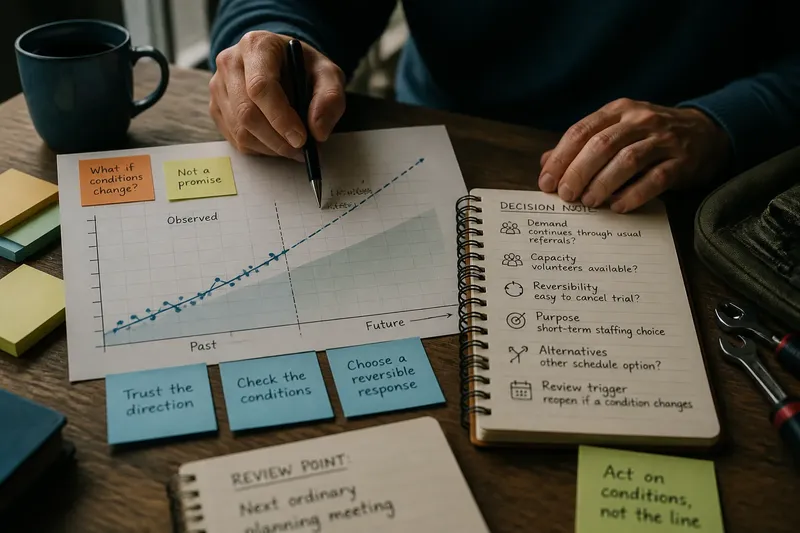
- Demand: If requests continue through the usual referral routes, then consider adding a session; if they fall back after a special event, keep the current schedule and review later.
- Capacity: If volunteers can cover the proposed session, then assess the change; if the rota is already full, keep the existing service and seek more capacity before expanding.
- Reversibility: If a trial session can be cancelled without disrupting other work, then a small trial may be suitable; if the commitment is difficult to undo, defer the decision until its conditions are clearer.
- Purpose: If the forecast supports a short-term staffing choice, use it for that choice; if someone wants to use it to justify a broader commitment, ask for a separate assessment.
- Alternatives: If a different schedule could meet the same need with less disruption, compare it before adding a session; if no workable alternative exists, state what makes the proposed change necessary.
- Review trigger: If an agreed condition changes, reopen the decision; if conditions remain as expected, keep the forecast as a working reference rather than treating it as a promise.
Imagine, for a worked example, that a coordinator has an invented planning note: requests rose after a community event, the volunteer rota is full, and the proposed evening session could be cancelled without changing existing sessions. The coordinator first separates the question of demand from the question of capacity. They then decide that demand must continue through ordinary referrals before expansion is considered, while the full rota rules out adding a session immediately. The resulting choice is to keep existing sessions open, check the source of later requests and revisit the proposal if volunteers become available. This does not decide whether interest is durable; it shows how the forecast’s conditions shape a reversible choice.
How can you review a forecast without chasing every new signal?
A review routine is useful because people can otherwise revisit a forecast whenever a striking new observation appears, or leave it untouched until a decision is already hard to change. Choose review points that fit the decision: a short interval can suit an active operational choice, while a less frequent review may suit a stable, easily adjusted plan. The intervals are not a rule; they give the team a deliberate moment to ask whether the assumptions still support the action.
- At the start of the review: Write the forecast’s claim, its time horizon and the decision it supports. If these are unclear, define them before using the estimate; otherwise, limit the forecast to the question it can actually address.
- Next: Record the observations behind the trend. If the information is consistent enough for the decision, continue to the conditions; if it is incomplete or distorted by an unusual event, treat the line as provisional and avoid relying on it alone.
- Then: Name the conditions the decision depends on, such as volunteer availability or access to a supplier. If a condition can be checked in ordinary work, use it as a review point; if it cannot, seek a more observable sign or make the decision less dependent on it.
- Before acting: Set out what happens if a condition holds and what happens if it does not. If the action remains sensible under either outcome, proceed with the chosen level of commitment; if it only works under one uncertain outcome, consider a smaller or more reversible choice.
- At the next planned review: Compare current conditions with the decision note. If the assumptions still fit, keep the forecast as a reference; if a condition has changed, revise the decision or stop using the line to support it.
For the repair service, the coordinator could choose the next ordinary planning meeting as the review point because that is when the rota and incoming referrals are already discussed. A new request alone would not force a change. If referrals continue through usual channels and volunteers become available, the proposed session can be reconsidered; if the rota remains full, the current schedule stays in place.
What should you do when the conditions change?
A temporary interruption does not necessarily mean the trend has ended. A closure, seasonal disruption or one-off event can affect what is observed without changing the conditions that usually produce the pattern. Decide in advance which changes matter to the choice, rather than letting the most recent event dictate the response.
Nor does a steady trend prove that its supporting conditions are unchanged. A service might retain the same level of use while its audience shifts. If the original reason for participation no longer applies, the same line may carry a different implication for future planning.
When the picture is uncertain, keep that uncertainty visible in the decision note. State which conditions remain in place, which are unclear and what action follows from each. That gives colleagues a clear basis for revisiting the choice without pretending the forecast has settled the matter.
Which straight-line forecast questions matter most?
What decision is this forecast meant to support?
Name the choice before discussing the projected direction. If the forecast is being used for a different decision than the one it was prepared for, treat it as context rather than as a sufficient basis for action.
Which conditions could change the choice?
Focus on conditions with practical consequences, such as staff availability or supplier access. If a condition changes but the decision would stay the same, it may not need close monitoring.
Can the decision be reversed?
An easily adjusted action can sometimes be taken while uncertainty remains, provided its limits are clear. If reversing the choice would be difficult, make the decision less dependent on the forecast’s most uncertain assumptions.
When should the forecast be revisited?
Set a review point around the decision’s needs, such as a scheduled planning meeting or a change in a named condition. This avoids both constant reaction to isolated observations and neglect of assumptions that have become outdated.
When is a straight-line forecast still useful?
A straight-line forecast can be a helpful reference when its purpose and conditions are clear. It can show what follows if a current direction continues, prompt a capacity question or provide a starting point for comparing possible actions. Its role is to inform a decision, not to decide on the team’s behalf.
Keep the condition attached to the claim: “If the present pattern and its supporting conditions continue, this is the direction we would expect.” Then say what decision the estimate informs and what change would prompt a review. That wording helps people use the forecast without mistaking it for a promise.
If a choice is difficult to reverse, ask whether it would still make sense if the trend slowed or turned. For a small, adjustable choice, a lighter review may be sufficient. A straight-line forecast is most useful when the team treats its assumptions as conditions for action, rather than as part of the chart’s furniture.